
Note: this blog post was written originally in 2016, but went unpublished until 2023.
When I started this blog, I knew that I wanted to write about what it means to live a sustainable lifestyle, but I didn’t know where to start. Now that I’ve experienced a large Earthquake, or Terremoto as they say here in Ecuador, I’ve been able to think about sustainability in a way I hadn’t thought of before.
Sustainability to me has always meant the bumper sticker quote of “Live simply so that others may simply live”. The overconsumption of resources in some areas of the world pollutes air and water, degrades the natural environment, leaves many communities without the essentials to simply live, and overall destabilizes economies and ecological systems – not to mention human health. But after experiencing the majesty of Pacha Mama, I see that sustainability is more than conserving and using resources responsibly: it is about forethought and resilience.
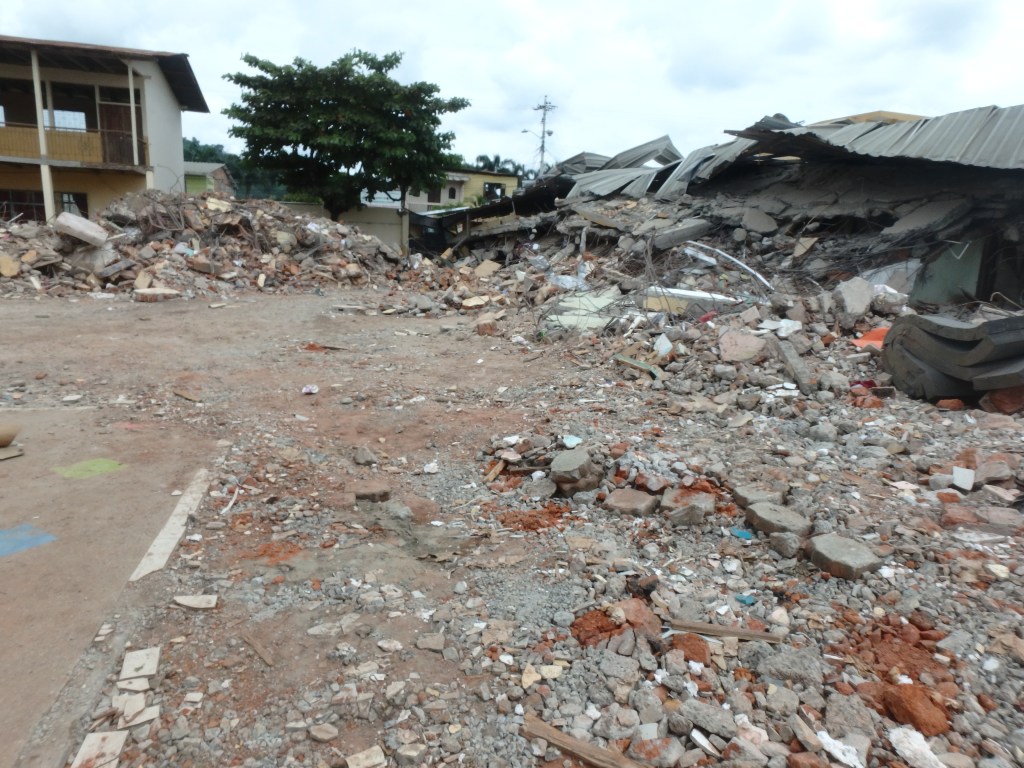
In Bahia de Caraquez, the town I’ve lived in for the past two months leading University and High School students from the U.S. on educational service trips in the Manabi region, the vast majority of buildings and homes have been destroyed. The entire city will need to be rebuilt in the coming months as the threat of aftershocks passes and the situation stabilizes. As this happens, the people will (ideally) be thinking about the best way to build their homes in order to be resilient to the next quakes. Throughout the Manabi region, as you pass through community after destroyed commmunity, it is clear that though the destruction has not been equally spread throughout the entire region due to the odd yet natural path of destruction, the majority of homes that remained in tact were build with bamboo and wood as opposed to the brick and cement buildings which appear to be the homes that were, across the board, almost entirely destroyed.
When considering this fact, it is also interesting to note that bamboo is a cheaper and more environmentally-friendly alternative to wood, cement, and bricks, as it takes less time to grow than wood, requires fewer inputs than cement or bricks, is incredibly sturdy and pliable, and is a more breathable material to live within in such a hot humid region of the world. So why do people build with the alternatives?
Cement is relatively cheap and easy to manipulate into any shape desired, and both cement and bricks are very sturdy in non-earthquake situations, making building a strong private home fairly simple. But still, if bamboo is such an abundant local resource, wouldn’t you expect more locals to build with it?
In order to aide the quake-struck communities in their rebuilding phase, the organization I currently work for (called the GSE – Global Student Embassy) is consulting local architects and contractors to design and build a model home for the surrounding communities to model their homes after. The idea is that the home will use environmentally friendly, cheap, locally available, and naturally-disaster-resilient building materials.
So what is Sustainability, in reality? It is resilience, community collaboration, local accessibility of resources, environmental consideration, and most of all, forethought. If future consequences are not considered, we will surely perish due to our neglect.
 A Sustainable Penny